AI earnings call summary: make the model cite the transcript
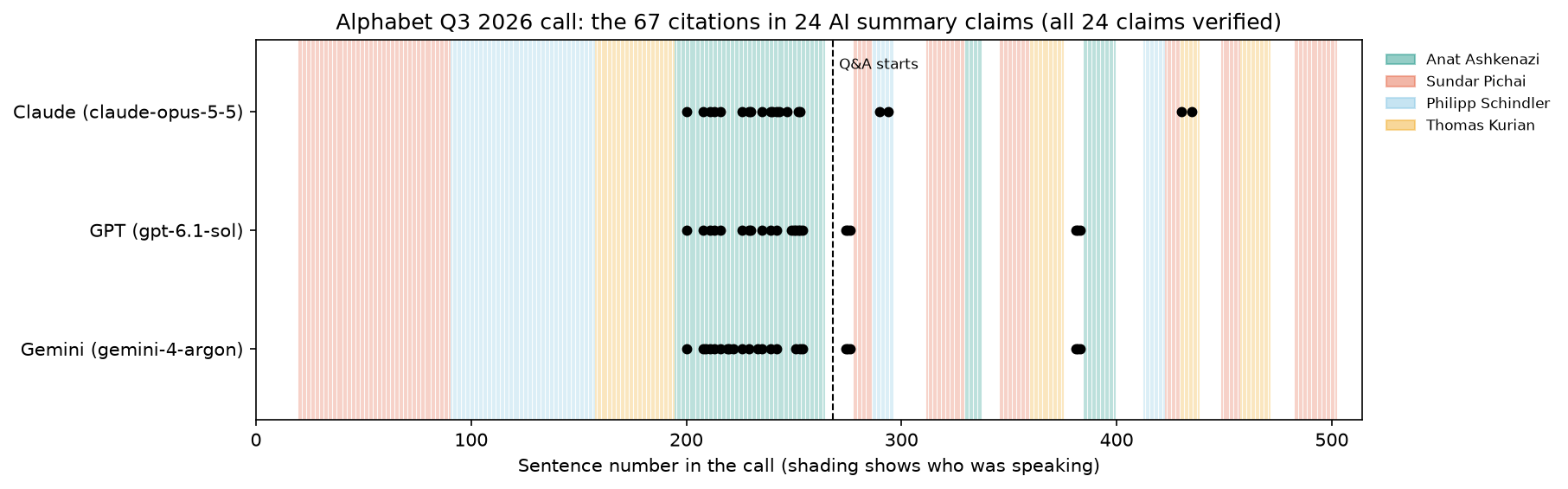
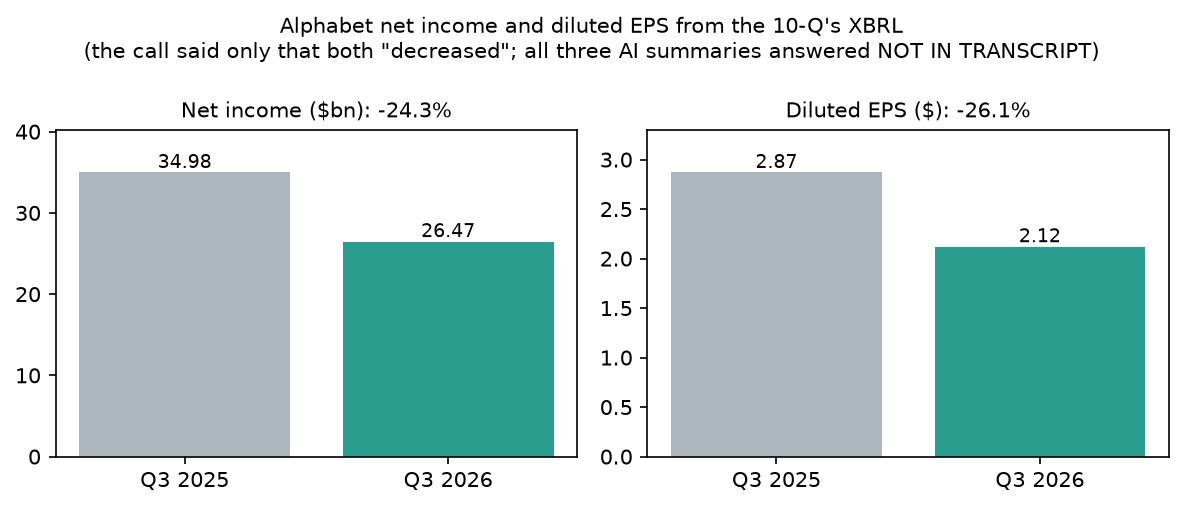
I numbered every sentence of Alphabet’s third-quarter 2026 earnings call, gave the file to Claude, GPT and Gemini, and asked each for an AI earnings call summary of eight claims, every claim citing the sentences behind it. A short Python check then graded all 24 claims: the cited sentences exist, the named speaker said them, and every number in the claim is in them. All 24 passed. My first prompt asked for copied quotes and did worse: Gemini pinned three figures, including a $561 billion Cloud backlog, to quotes that didn’t contain them, though the CFO did say all three on the call. The check also shows what the summaries skip. Sundar Pichai spoke 148 sentences and none of the 67 citations is one of them. And nobody could say what Alphabet earned, because the call never does. The 10-Q does: net income of $26.5 billion, down 24.3%.
The setup: one numbered transcript, three models, one prompt
Alphabet posts its own call transcripts on its investor relations site. The third-quarter call ran on 28 October 2026, the day Alphabet filed its results release on Form 8-K, and the 10-Q followed on 29 October.
Each model got the numbered transcript as a text file in an otherwise empty working folder and ran headless on 21 November 2026: Claude Code 2.1.328 with claude-opus-5-5, OpenAI’s Codex CLI 0.170.0 with gpt-6.1-sol in its read-only sandbox, and OpenCode 2.2.7 with gemini-4-argon. The prompt:
The file alphabet-q3-2026-numbered.txt in this folder is the transcript of Alphabet's third-quarter 2026 earnings
call (28 October 2026), one sentence per line, each with an ID in square brackets and the speaker's name. Using only
that file, write an earnings call summary as exactly 8 claims an investor would want: headline results, segment
results, cash flow and capital expenditure, the outlook, and what analysts pressed management on.

Rules:
1. Each claim is one sentence in your own words.
2. Each claim cites the IDs of the one to three transcript sentences that support it, and names the person who
   said them.
3. Every number in a claim must appear in a sentence it cites.
4. Then answer two fixed questions: Alphabet's Q3 2026 net income and diluted earnings per share. If the call does
   not state a figure, the answer is "NOT IN TRANSCRIPT".

Reply with one JSON object and nothing else:
{"claims": [{"claim": "...", "sources": ["S1"], "speaker": "..."}], "net_income": "...", "diluted_eps": "..."}
The JSON is the point. A paragraph of summary reads well and can only be checked by reading the call again. A list of claims, sentence IDs and speakers can be checked by a short script, and a sentence ID is cheaper for the model to get right than a 25-word quote copied character for character. I also gave all three models the unnumbered transcript with a plain request for an earnings call summary in under 250 words. They read well, and every figure about Alphabet in them turns up somewhere in the call. Finding that out took a separate search for each number, with no sentence or speaker to say where it came from, which is the whole problem with prose summaries.
One thing matters if you want to reproduce this. The working folder sat inside my research notes. Claude Code reads the CLAUDE.md files above its working folder, and mine asks for cited sources and an explicit flag when a fact is missing from a document. OpenCode reads the same files when it finds no AGENTS.md, and Codex reads AGENTS.md, which on my machine covers only how I maintain my tool setup. So Claude and Gemini had a nudge toward “say when it isn’t there” before they read a word of the prompt, and it shows: Claude’s plain summary labelled the missing figures NOT IN DOCUMENT, which is my CLAUDE.md’s phrase.
Step 1: turn Alphabet’s PDF into text with no PDF library
The transcript is a PDF, and its metadata gives the game away. The title ends in “- Google Docs” and the creator is Chrome on a Mac, so Alphabet’s investor relations team uses the products, at least. That turns out to be convenient, because a PDF that simple can be read with the standard library: decompress each page stream, map the font’s glyph ids back to characters, join the text.
import os
import re
import zlib
import requests
import pandas as pd
import matplotlib.pyplot as plt

PDF_URL = ("https://s206.q4cdn.com/479360582/files/doc_events/2026/Oct/28/"
           "2026_Q3_Earnings_Transcript.pdf")


def pdf_text(data):
    """Text of a simple PDF (Flate streams, ToUnicode fonts) using only the standard library."""
    objs = {int(n): body for n, body in re.findall(rb"(\d+) 0 obj(.*?)endobj", data, re.S)}

    def stream(body):
        m = re.search(rb"stream\r?\n(.*?)\r?\nendstream", body, re.S)
        return zlib.decompress(m.group(1)).decode("latin1") if m else ""

    def cmap(body):
        """Glyph id -> character, from a font's ToUnicode table."""
        out = {}
        for block in re.findall(r"beginbfchar(.*?)endbfchar", body, re.S):
            for a, b in re.findall(r"<(\w+)>\s*<(\w+)>", block):
                out[int(a, 16)] = bytes.fromhex(b).decode("utf-16-be")
        for block in re.findall(r"beginbfrange(.*?)endbfrange", body, re.S):
            for a, b, c in re.findall(r"<(\w+)>\s*<(\w+)>\s*<(\w+)>", block):
                for i in range(int(a, 16), int(b, 16) + 1):
                    out[i] = chr(int(c, 16) + i - int(a, 16))
        return out

    fonts = {}
    for n, body in objs.items():
        m = re.search(rb"/ToUnicode (\d+) 0 R", body)
        if m:
            fonts[n] = cmap(stream(objs[int(m.group(1))]))
    names = {name.decode(): fonts[int(ref)] for body in objs.values()
             for name, ref in re.findall(rb"/(\w+) (\d+) 0 R", body) if int(ref) in fonts}
    parts = []
    for body in objs.values():
        if b"stream" not in body or b"/Length" not in body:
            continue
        try:
            content = stream(body)
        except zlib.error:
            continue
        font = None
        for f, hexstr, et in re.findall(r"/(\w+) [\d.]+ Tf|<([0-9A-Fa-f]*)>|(ET)", content):
            if f:
                font = names.get(f)
            elif hexstr and font is not None:
                parts.append("".join(font.get(int(hexstr[i:i + 4], 16), "") for i in range(0, len(hexstr), 4)))
            elif et:
                parts.append(" ")
    return re.sub(r"\s+", " ", "".join(parts)).strip()


pdf = requests.get(PDF_URL, timeout=60).content
transcript = pdf_text(pdf)
print(re.search(rb"/Title \((.*?)\)", pdf).group(1).decode())
print(f"{len(transcript.split()):,} words")
2026_Q3_Earnings_Transcript - Google Docs
9,048 wordsIf your transcript comes from another source and this helper returns junk, install pypdf and use its extract_text(); nothing below cares where the text came from.
Step 2: number every sentence and keep the speaker
Alphabet’s transcript writes every turn as “Name, Title:” and the operator as plain “Operator:”, so one regular expression finds the turns and a second one splits each turn into sentences. The code writes the numbered file the models read, one line per sentence: an ID, the speaker, the text.
# Each speaker turn starts with "Name, Title:" (the operator has no title)
TURN = re.compile(r"(Operator|[A-Z][\w.]+ [A-Z][\w-]+, [^:]{2,60}):")
SENTENCE_END = re.compile(r"(?<=[.?!])\s+(?=[A-Z$\"'0-9])")


def sentences(text):
    """(id, speaker, sentence) for every sentence in the call, numbered S1, S2, ... in order."""
    marks = list(TURN.finditer(text))
    rows = []
    for i, m in enumerate(marks):
        turn = text[m.end():marks[i + 1].start() if i + 1 < len(marks) else None]
        for s in SENTENCE_END.split(turn.strip()):
            rows.append((f"S{len(rows) + 1}", m.group(1).split(",")[0], s))
    return pd.DataFrame(rows, columns=["id", "speaker", "text"]).set_index("id")


call = sentences(transcript)
with open("alphabet-q3-2026-numbered.txt", "w") as f:   # the file each model reads
    f.writelines(f"[{i}] {r.speaker}: {r.text}\n" for i, r in call.iterrows())
turn_count = sum(1 for _ in TURN.finditer(transcript))
print(f"{len(call):,} sentences in {turn_count} turns from {call['speaker'].nunique()} speakers")
print(call["speaker"].value_counts().head(5).to_string())
514 sentences in 39 turns from 13 speakers
speaker
Sundar Pichai 148
Anat Ashkenazi 93
Philipp Schindler 87
Thomas Kurian 76
Operator 31514 sentences, and the CEO has the most of them, 148. Keep this file next to the models’ replies. The IDs only mean something against the exact split that produced them, so if you change the splitter, the old citations point at the wrong sentences.
Step 3: check every citation
I saved each model’s reply as JSON and copied its claims, IDs and speakers into the code below as the model wrote them, except that I turned their long dashes into commas and hyphens. The check asks three questions per claim. Do the cited IDs exist? Did the named speaker say every cited sentence? And is every number in the claim also in the cited sentences? A period label like “Q3 2026” doesn’t count as a figure to cite. When a number is missing, the code lists the sentences where it does appear, which separates an invented number from a misplaced citation. The last few lines record where in the call each citation sits.
# Each model's saved JSON reply: (claim, cited sentence ids, speaker), copied as the model wrote them
SUMMARIES = {
    "Claude (claude-opus-5-5)": [
        ("Alphabet's consolidated revenue rose 25% to $127.6 billion, and operating income rose 30% to $40.6 billion, an operating margin of 31.8%.",
         ["S201", "S209"], "Anat Ashkenazi"),
        ("Google Services revenue grew 11% to $96.3 billion; within it, Search and other advertising grew 12% to $63.3 billion and YouTube advertising grew 9% to $11.2 billion.",
         ["S227", "S230", "S231"], "Anat Ashkenazi"),
        ("Google Cloud revenue rose 103% to $30.7 billion, and its operating income reached $11.1 billion as the segment's operating margin widened from 23.7% a year earlier to 36.2%.",
         ["S236", "S240", "S241"], "Anat Ashkenazi"),
        ("Google Cloud's backlog stood at $561 billion, and management expects just over 55% of it to be recognized as revenue over the next 24 months.",
         ["S243", "S244"], "Anat Ashkenazi"),
        ("Operating cash flow of $42.3 billion fell short of capital expenditure of $51.4 billion, leaving free cash flow negative at $9.1 billion for the quarter.",
         ["S212", "S214", "S217"], "Anat Ashkenazi"),
        ("For the outlook, management kept its full-year capital expenditure guidance of $195-$205 billion, expects a somewhat larger foreign-exchange headwind in the fourth quarter, and expects near-term Cloud margin pressure from using third-party compute capacity.",
         ["S254", "S248", "S253"], "Anat Ashkenazi"),
        ("Pressed on why Search revenue growth slowed even though query growth was strong, Schindler named foreign exchange as the largest cause and said fast growth in AI Mode queries, which earn less from ads, also weighed on it.",
         ["S291", "S295"], "Philipp Schindler"),
        ("Asked whether TPU system sales are a good business, Kurian would not give margins for individual products but said every TPU system in inventory is tied to a signed customer contract.",
         ["S431", "S436"], "Thomas Kurian"),
    ],
    "GPT (gpt-6.1-sol)": [
        ("Alphabet revenue rose 25% to $127.6 billion, while operating income increased 30% to $40.6 billion with a 31.8% operating margin.",
         ["S201", "S209"], "Anat Ashkenazi"),
        ("Google Services revenue grew 11% to $96.3 billion, including Search advertising growth of 12% to $63.3 billion and YouTube advertising growth of 9% to $11.2 billion.",
         ["S227", "S230", "S231"], "Anat Ashkenazi"),
        ("Google Cloud revenue increased 103% to $30.7 billion, operating income more than tripled to $11.1 billion, and backlog reached $561 billion.",
         ["S236", "S240", "S243"], "Anat Ashkenazi"),
        ("Operating cash flow of $42.3 billion fell short of capital expenditure of $51.4 billion, leaving negative free cash flow of $9.1 billion.",
         ["S212", "S214", "S217"], "Anat Ashkenazi"),
        ("Management expected TPU system sales to scale in Q4 before a meaningful revenue ramp in 2027, maintained 2026 capital expenditure guidance of $195-$205 billion, and anticipated significantly higher capital expenditure in 2027.",
         ["S251", "S254", "S255"], "Anat Ashkenazi"),
        ("Management expected tougher Search comparisons to pressure Q4 revenue growth and greater use of third-party computing capacity to weigh on Cloud margins in the near term.",
         ["S250", "S252", "S253"], "Anat Ashkenazi"),
        ("Douglas Anmuth pressed management on why Search revenue growth was slowing despite the fastest query growth in five years and whether limited advertising in AI search experiences explained the gap.",
         ["S275", "S276", "S277"], "Douglas Anmuth"),
        ("Ross Sandler pressed management on how much TPU system spending becomes Alphabet revenue, the resulting margin contribution, and whether customers building their own infrastructure could reduce Alphabet's capital expenditure intensity.",
         ["S382", "S383", "S384"], "Ross Sandler"),
    ],
    "Gemini (gemini-4-argon)": [
        ("In the third quarter, consolidated revenue rose 25% to $127.6 billion and operating income grew 30% to $40.6 billion for a 31.8% operating margin, while other income and expenses was negative $8.2 billion largely from an unrealized SpaceX investment loss.",
         ["S201", "S209", "S210"], "Anat Ashkenazi"),
        ("Google Services revenue grew 11% to $96.3 billion, led by Google Search and other advertising revenue rising 12% to $63.3 billion, while segment operating income increased 17% to $39.2 billion at a 40.7% operating margin.",
         ["S227", "S230", "S234"], "Anat Ashkenazi"),
        ("Google Cloud revenue jumped 103% to $30.7 billion on AI and Core GCP demand, segment operating income more than tripled to $11.1 billion, and the Google Cloud backlog reached $561 billion in the third quarter.",
         ["S236", "S240", "S243"], "Anat Ashkenazi"),
        ("Although third quarter operating cash flow was $42.3 billion ($179.6 billion over the trailing 12 months), technical infrastructure CapEx of $51.4 billion resulted in negative free cash flow of $9.1 billion for the third quarter.",
         ["S212", "S214", "S217"], "Anat Ashkenazi"),
        ("Alphabet finished the third quarter with $265.1 billion in cash and marketable securities (including $90.4 billion in marketable equity securities), $125.1 billion in long-term debt, $924 billion in future purchase commitments, and $152 billion in pre-commencement leases and other obligations.",
         ["S220", "S221", "S223"], "Anat Ashkenazi"),
        ("Management maintained full-year 2026 CapEx guidance at $195-$205 billion while projecting a significant CapEx increase in 2027 and near-term Cloud margin pressure as third-party compute capacity usage ramps in Q4 after starting at the end of Q3.",
         ["S252", "S254", "S255"], "Anat Ashkenazi"),
        ("During the question-and-answer session, Douglas Anmuth pressed management on the disconnect between query growth reaching its fastest pace in five years and the deceleration in Search growth, asking whether lower ad loads in AI Overviews and AI Mode were responsible.",
         ["S275", "S276", "S277"], "Douglas Anmuth"),
        ("Ross Sandler pressed management on the revenue recognition and margin profile of TPU system sales, citing an estimated $35 billion cost per gigawatt, and asked whether helping AI labs like Anthropic build first-party infrastructure would reduce Alphabet's own CapEx intensity.",
         ["S382", "S383", "S384"], "Ross Sandler"),
    ],
}


NUMBER = re.compile(r"\d+(?:\.\d+)?")
PERIOD = re.compile(r"\bQ[1-4](?: \d{4})?\b")  # "Q3 2026" labels the period; it is not a figure to cite


def numbers(text):
    """Every number in a piece of text, commas removed ("$1,234.5" -> "1234.5")."""
    return NUMBER.findall(PERIOD.sub("", text).replace(",", ""))


def check(claim, ids, speaker):
    """Do the cited sentences exist, did the named speaker say them, and do they hold every number in the claim?"""
    cited = call.reindex(ids)
    if cited["text"].isna().any():
        return "id not found", ", ".join(i for i in ids if i not in call.index)
    if not (cited["speaker"] == speaker.split(",")[0]).all():
        return "wrong speaker", ", ".join(cited["speaker"].unique())
    missing = [n for n in numbers(claim) if n not in numbers(" ".join(cited["text"]))]
    if not missing:
        return "verified", ""
    where = {n: call.index[call["text"].map(lambda t: n in numbers(t))].tolist() for n in missing}
    return "number not in cited sentences", "; ".join(f"{n} in {', '.join(w[:2]) or 'no sentence'}"
                                                      for n, w in where.items())


rows = [(model, i + 1, *check(*c)) for model, claims in SUMMARIES.items() for i, c in enumerate(claims)]
checks = pd.DataFrame(rows, columns=["model", "claim", "result", "detail"])
print(checks.groupby("model")["result"].value_counts().unstack(fill_value=0).to_string())
failed = checks[checks["result"] != "verified"]
print(failed.to_string(index=False) if len(failed) else "every claim verified")
# Where in the call do the cited sentences sit?
qa_start = call.index.get_loc(call[call["text"].str.contains("first question")].index[0])
cited = pd.DataFrame([(model, i + 1, sid, call.index.get_loc(sid)) for model, claims in SUMMARIES.items()
                      for i, (_, ids, _) in enumerate(claims) for sid in ids],
                     columns=["model", "claim", "id", "position"])
cited["speaker"] = call.loc[cited["id"], "speaker"].values
cited["part"] = (cited["position"] >= qa_start).map({False: "prepared remarks", True: "Q&A"})
print(f"Q&A starts at sentence S{qa_start + 1} of {len(call)}")
print(pd.crosstab(cited["model"], cited["part"]).to_string())
print(cited["speaker"].value_counts().to_string())
result verified
model
Claude (claude-opus-5-5) 8
GPT (gpt-6.1-sol) 8
Gemini (gemini-4-argon) 8
every claim verified
Q&A starts at sentence S269 of 514
part Q&A prepared remarks
model
Claude (claude-opus-5-5) 4 16
GPT (gpt-6.1-sol) 6 17
Gemini (gemini-4-argon) 6 18
speaker
Anat Ashkenazi 51
Douglas Anmuth 6
Ross Sandler 6
Philipp Schindler 2
Thomas Kurian 2All 24 claims pass. The map is the more interesting output. 51 of the 67 citations point to sentences by the CFO, Anat Ashkenazi, who spoke 93 of the call’s 514. The Q&A starts at sentence 269 and covers 48% of the call, but only 16 citations land there. Ask for “headline results, segment results, cash flow” and you get the CFO’s script back, re-ordered. That’s a fair summary of the numbers and a thin one of the call: whatever Pichai said about models and agents, none of the three summaries kept it.
Where the AI earnings call summary went wrong
The errors came in the first version of the prompt, which asked for a word-for-word quote of up to 25 words per claim in place of sentence IDs. Every quote from all three models was genuine and correctly attributed, and Claude’s and GPT’s claims held. Three of Gemini’s eight did not. It put the $561 billion Cloud backlog in a claim backed by a quote about Cloud operating income, the $42.3 billion of operating cash flow in a claim backed by a quote about capital expenditure, and a 2027 capital spending increase in a claim backed by the unchanged 2026 guidance. All three figures are in the transcript, a few sentences from where Gemini quoted. So the numbers were right and the citations didn’t support them, which is the failure a reader who trusts the format and doesn’t click will never see. The sentence-ID round fixed that on this call. One call is too small a sample to say IDs always beat quotes, but they gave the models less to copy and me less to check.
The check has a blind spot. It confirms that a cited sentence exists, has the right speaker and holds the claim’s figures. It can’t confirm the sentence supports what the claim says. I read all 24 claims against their cited sentences. None bent the meaning, but some lean on a sentence they don’t cite. Claude says Philipp Schindler named foreign exchange as the largest cause of the Search slowdown, citing S291: “It was the single largest driver of Search deceleration relative to Q2.” The “it” is FX, and FX is in S290, which Claude didn’t cite. The code passes the claim, fairly, since it has no number to miss, and a reader who opens S291 alone has to scroll up a line to see it’s right. That part is reading, and no regular expression will do it for you.
Then there’s the question this transcript can’t answer. Alphabet’s other income was a loss of $8.2 billion in the quarter, mostly an unrealized loss on its SpaceX stake, and the CFO said only that “net income and earnings per share decreased due to the decline in OI&E”, according to the transcript. In both prompt versions all three models answered NOT IN TRANSCRIPT for both figures, and the plain summaries said the same in their own words. That’s the right answer, and a slightly embarrassing one for a call summary. So the last step takes those figures from the 10-Q’s XBRL and checks the call’s own figures while it’s there. It uses the SEC’s free company facts API, which the SEC EDGAR API tutorial covers in detail.
# The 10-Q for the same quarter, from the SEC's XBRL API
# The SEC asks every script to identify itself. Set your own contact first:
#   export SEC_USER_AGENT="Your Name you@example.com"
HEADERS = {"User-Agent": os.environ["SEC_USER_AGENT"]}
CIK = 1652044                    # Alphabet Inc.
ACCN = "0001652044-26-000084"    # the 10-Q for the quarter ended 30 September 2026, filed 29 October 2026
url = f"https://data.sec.gov/api/xbrl/companyfacts/CIK{CIK:010d}.json"
gaap = requests.get(url, headers=HEADERS, timeout=60).json()["facts"]["us-gaap"]


def fact(concept, start, end, unit="USD"):
    """The value Alphabet's 10-Qs tagged for one concept and period (latest filing wins)."""
    hits = [f for f in gaap[concept]["units"][unit] if f.get("start") == start and f["end"] == end]
    return sorted(hits, key=lambda f: f["filed"])[-1]["val"]


def quarter(concept, unit="USD"):
    """Q3 2026, three months to 30 September 2026."""
    return fact(concept, "2026-07-01", "2026-09-30", unit)


def q3_from_ytd(concept):
    """Cash flow lines are year-to-date in a 10-Q: nine months minus six months."""
    return fact(concept, "2026-01-01", "2026-09-30") - fact(concept, "2026-01-01", "2026-06-30")


def said(phrase):
    """The dollar figure (USD billions) that follows a phrase in the transcript."""
    return float(re.search(re.escape(phrase) + r" \$([\d.]+) billion", transcript).group(1))


# What the CFO said on the call, next to what the 10-Q tagged for the same line
SAID = {
    "Revenue": (said("Consolidated revenues were"), quarter("Revenues")),
    "Operating income": (said("Operating income increased 30% to"), quarter("OperatingIncomeLoss")),
    "Cost of revenue": (said("Total cost of revenue was"), quarter("CostOfRevenue")),
    "Operating cash flow": (said("strong operating cash flow of"),
                            q3_from_ytd("NetCashProvidedByUsedInOperatingActivities")),
    "Capital expenditure": (said("CapEx was"), q3_from_ytd("PaymentsToAcquirePropertyPlantAndEquipment")),
    "Long-term debt": (said("Long-term debt was"), [f["val"] for f in gaap["LongTermDebtNoncurrent"]["units"]["USD"]
                                                    if f["end"] == "2026-09-30" and f["accn"] == ACCN][0]),
}
vs_filing = pd.DataFrame(SAID, index=["call ($bn)", "10-Q ($bn)"]).T
vs_filing["10-Q ($bn)"] /= 1e9
vs_filing["gap ($m)"] = (vs_filing["call ($bn)"] - vs_filing["10-Q ($bn)"]) * 1000
print(vs_filing.round(3).to_string())

# What the call left out: it said net income and EPS "decreased", with no figures
gap = pd.DataFrame({
    "Q3 2025": [fact("NetIncomeLoss", "2025-07-01", "2025-09-30") / 1e9,
                fact("EarningsPerShareDiluted", "2025-07-01", "2025-09-30", "USD/shares")],
    "Q3 2026": [quarter("NetIncomeLoss") / 1e9, quarter("EarningsPerShareDiluted", "USD/shares")],
}, index=["Net income ($bn)", "Diluted EPS ($)"])
gap["change"] = gap["Q3 2026"] / gap["Q3 2025"] - 1
print(gap.round(3).to_string())
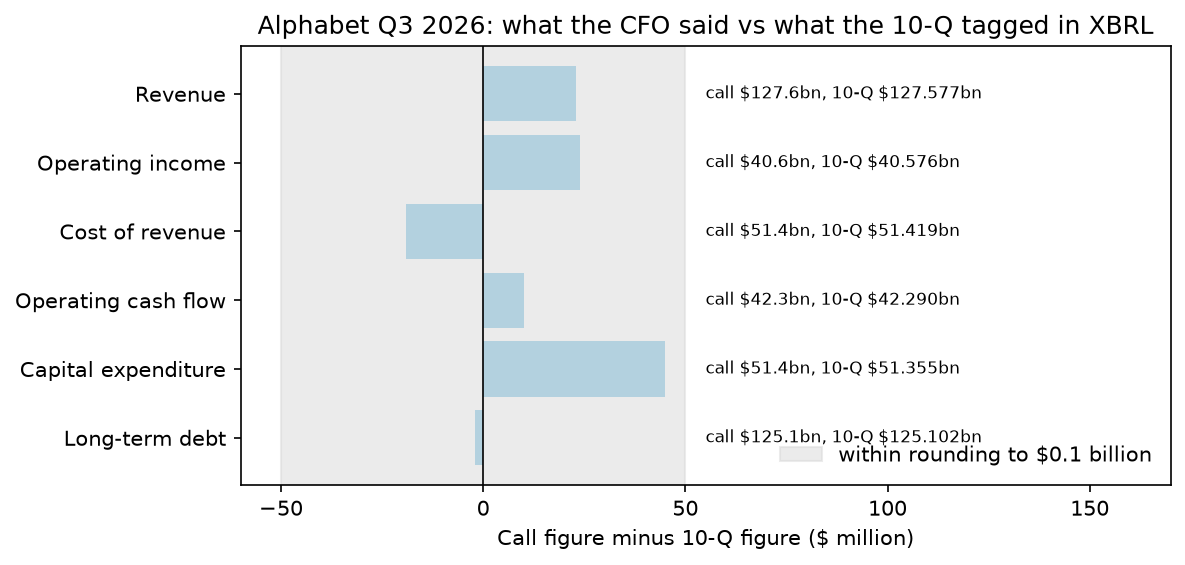
call ($bn) 10-Q ($bn) gap ($m)
Revenue 127.6 127.577 23.0
Operating income 40.6 40.576 24.0
Cost of revenue 51.4 51.419 -19.0
Operating cash flow 42.3 42.290 10.0
Capital expenditure 51.4 51.355 45.0
Long-term debt 125.1 125.102 -2.0
Q3 2025 Q3 2026 change
Net income ($bn) 34.979 26.468 -0.243
Diluted EPS ($) 2.870 2.120 -0.261All six call figures checked here match the 10-Q within rounding to a tenth of a billion. The largest gap is capital expenditure, $51.4 billion on the call against $51.35 billion in the cash flow statement. Net income was $26.5 billion against $35.0 billion a year earlier, and diluted earnings per share fell 26.1% to $2.12. One more trap sits in that table. Total cost of revenue, $51.42 billion in the 10-Q, and capital expenditure both round to $51.4 billion on the call. A check that only matches numbers can’t tell which of the two a claim means. The sentence ID can.
# Chart 1: where the 24 claims point in the call
SPEAKER_COLORS = {"Anat Ashkenazi": "#2a9d8f", "Sundar Pichai": "#e76f51", "Philipp Schindler": "#8ecae6",
                  "Thomas Kurian": "#f2b134"}
fig, ax = plt.subplots(figsize=(11, 3.8))
pos = call.reset_index()
for name, color in SPEAKER_COLORS.items():
    xs = pos.index[pos["speaker"] == name]
    ax.vlines(xs, -0.6, len(SUMMARIES) - 0.4, color=color, alpha=0.3, lw=1)
ax.axvline(qa_start, color="black", lw=1, ls="--")
ax.text(qa_start + 3, -0.45, "Q&A starts", fontsize=8, va="top")
for y, model in enumerate(SUMMARIES):
    sub = cited[cited["model"] == model]
    ax.scatter(sub["position"], [y] * len(sub), color="black", s=22, zorder=3)
ax.set_yticks(range(len(SUMMARIES)), list(SUMMARIES))
ax.set_ylim(len(SUMMARIES) - 0.4, -0.6)
ax.set_xlim(0, len(call))
ax.set_xlabel("Sentence number in the call (shading shows who was speaking)")
ax.legend(handles=[plt.Rectangle((0, 0), 1, 1, color=c, alpha=0.5) for c in SPEAKER_COLORS.values()],
          labels=list(SPEAKER_COLORS), loc="upper left", bbox_to_anchor=(1.01, 1), frameon=False, fontsize=8)
ax.set_title(f"Alphabet Q3 2026 call: the {len(cited)} citations in {len(checks)} AI summary claims "
             f"(all {int((checks['result'] == 'verified').sum())} claims verified)")
plt.savefig("googl-ai-earnings-call-summary-check.png", dpi=150, bbox_inches="tight")

# Chart 2: the call's rounded figures against the 10-Q
plt.rcParams["text.parse_math"] = False   # print "$" as a dollar sign, not as math markup
fig, ax = plt.subplots(figsize=(8, 3.8))
ax.barh(vs_filing.index, vs_filing["gap ($m)"], color="#8ecae6")
ax.axvspan(-50, 50, color="#d9d9d9", alpha=0.5, label="within rounding to $0.1 billion")
ax.axvline(0, color="black", lw=0.8)
for y, (name, r) in enumerate(vs_filing.iterrows()):
    ax.text(55, y, f"call ${r['call ($bn)']:.1f}bn, 10-Q ${r['10-Q ($bn)']:.3f}bn", va="center", fontsize=8)
ax.invert_yaxis()
ax.set_xlim(-60, 170)
ax.set_xlabel("Call figure minus 10-Q figure ($ million)")
ax.legend(loc="lower right", frameon=False)
ax.set_title("Alphabet Q3 2026: what the CFO said vs what the 10-Q tagged in XBRL")
plt.savefig("googl-call-vs-10q.png", dpi=150, bbox_inches="tight")

# Chart 3: the figures the call never gave
fig, axes = plt.subplots(1, 2, figsize=(8, 3.4))
for ax, (name, r) in zip(axes, gap.iterrows()):
    ax.bar(["Q3 2025", "Q3 2026"], [r["Q3 2025"], r["Q3 2026"]], color=["#adb5bd", "#2a9d8f"])
    for x, v in enumerate([r["Q3 2025"], r["Q3 2026"]]):
        ax.text(x, v, f"{v:,.2f}", ha="center", va="bottom", fontsize=9)
    ax.set_ylim(0, max(r["Q3 2025"], r["Q3 2026"]) * 1.15)
    ax.set_title(f"{name}: {r['change']:+.1%}", fontsize=10)
fig.suptitle("Alphabet net income and diluted EPS from the 10-Q's XBRL\n"
             "(the call said only that both \"decreased\"; all three AI summaries answered NOT IN TRANSCRIPT)",
             fontsize=10)
plt.tight_layout()
plt.savefig("googl-net-income-not-in-call.png", dpi=150, bbox_inches="tight")

ceo = call["speaker"] == "Sundar Pichai"
figures = {
    "words": len(transcript.split()),
    "n_sentences": len(call),
    "n_turns": turn_count,
    "n_speakers": call["speaker"].nunique(),
    "qa_start": qa_start + 1,
    "qa_share": 1 - qa_start / len(call),
    "n_claims": len(checks),
    "n_verified": int((checks["result"] == "verified").sum()),
    "n_cited": len(cited),
    "cfo_cited": int((cited["speaker"] == "Anat Ashkenazi").sum()),
    "qa_cited": int((cited["part"] == "Q&A").sum()),
    "ceo_sentences": int(ceo.sum()),
    "ceo_cited": int((cited["speaker"] == "Sundar Pichai").sum()),
    "cfo_sentences": int((call["speaker"] == "Anat Ashkenazi").sum()),
    "capex_call": vs_filing.loc["Capital expenditure", "call ($bn)"] * 1e9,
    "capex_10q": vs_filing.loc["Capital expenditure", "10-Q ($bn)"] * 1e9,
    "cor_10q": vs_filing.loc["Cost of revenue", "10-Q ($bn)"] * 1e9,
    "ni_2026": gap.loc["Net income ($bn)", "Q3 2026"] * 1e9,
    "ni_2025": gap.loc["Net income ($bn)", "Q3 2025"] * 1e9,
    "ni_change": -gap.loc["Net income ($bn)", "change"],
    "eps_2026": gap.loc["Diluted EPS ($)", "Q3 2026"],
    "eps_change": -gap.loc["Diluted EPS ($)", "change"],
}
This is the same idea as the XBRL check on AI answers about ASML, pointed at a different source. There, the models answered from memory and the filing graded them. Here, the models had the document in hand and the grading is about whether they stuck to it.
What can go wrong
The PDF helper is fragile by design. It handles this transcript’s simple layout and nothing fancier: scanned pages, encrypted files or fonts without a ToUnicode table will come back empty or garbled. Check the word count and the sentence count before trusting anything downstream, and switch to pypdf when they look wrong.
The sentence splitter is a regular expression, and abbreviations break it. “U.S.” or “Inc.” mid-sentence will start a new sentence, which is harmless for the check as long as the models read the same file the code grades. The speaker split only works because Alphabet writes “Name, Title:” every time. Other companies use bold names on their own line, “Q -” and “A -” markers, or nothing at all, and a pattern written for one transcript will silently merge turns on another. Print the speaker counts every time, as the code does.
The number match is literal, and it fails in two directions. An Other Bets loss written as “$2.0 billion” won’t match the “$2 billion” the CFO said on the call, so a correct claim shows up as a miss you then clear by hand. A quantity written in words, such as “more than doubled” in place of the 103% Cloud growth, has no digits for the code to find, so it passes unchecked. Those are the claims to read yourself.
Long calls and several calls at once push against context limits. This one was 9,048 words, which all three handled in a single pass. If you feed a model a quarter’s worth of calls, check that it read all of them before you check what it said.
Transcripts are copyrighted. Quote short passages, link the source, and don’t republish the transcript. Sentence IDs help here too: the replies, the code and this post carry claims and IDs, and the text stays where Alphabet put it.
For the older, non-AI approach to the same document, word counts and keyword tracking in a transcript, see earnings call transcript analysis in Python and the sentiment analysis post that follows it.
What to watch
The CFO said Alphabet expects capital spending “to increase significantly in 2027” and that the company would “provide further details on our Q4 call”, as the transcript puts it. That fourth-quarter call is the next test: a 2027 capex range is exactly the kind of number a summary will want to state and a cited sentence has to carry. There’s no 10-Q for a fourth quarter, so the XBRL step will read the 10-K’s full-year figures and take the quarter as the year minus the first nine months, the same subtraction the cash flow lines already need. The other thing to watch is the map: if the next call’s summaries still skip the CEO entirely, the prompt’s list of topics is doing the summarizing. Model versions also move faster than earnings seasons, so the versions below are what these results apply to. Alphabet runs through other posts here too: the DCF Claude Code built for it and three models reading its 10-K.
My longer company research is published on the newsletter Sector Playbook, which is available by email subscription.
Sources
Alphabet’s Q3 2026 earnings call transcript from its investor relations site; its Q3 2026 results release, 10-Q for the quarter ended 30 September 2026 and XBRL company facts on SEC EDGAR; the SEC’s EDGAR API documentation; the documentation for Claude Code non-interactive mode and CLAUDE.md files, Codex non-interactive mode and AGENTS.md, and OpenCode’s CLI and rules files.
Tested 21 November 2026 with Claude Code 2.1.328 (claude-opus-5-5), Codex CLI 0.170.0 (gpt-6.1-sol) and OpenCode 2.2.7 (gemini-4-argon); checking code run with Python 3.12.14, matplotlib 3.11.2, pandas 3.1.0, requests 2.34.2.
Disclaimer
Disclosure: I hold long GOOGL shares. I also hold diversified funds (IWDA, QQQ, SPY, VWRL) that may include GOOGL. Positions checked on 21 November 2026.
This article is general information about a listed company, written for educational purposes. It is not investment advice and not a personal recommendation to buy, sell or hold any security, and it does not take into account anyone’s financial situation or objectives. I am not a registered investment adviser or a licensed financial services provider. Figures come from company filings and the other sources linked in the text, as of the dates given, and may have changed since. I may hold positions in the securities discussed; see the disclosure above. Investment decisions call for independent research or the advice of a licensed professional.
This is my own research, done with the help of AI tools.