How does Lumentum make money?
Updated 22 October 2026.
Disclosure: I have no position in LITE. Of the other companies discussed, I hold long NVDA shares. I have no position in COHR or AMD. I also hold diversified funds (IWDA, QQQ, SPY, VWRL) that may include some of these companies. Positions checked on 22 October 2026.
Lumentum makes money by selling optical hardware built mostly around lasers. Some of it leaves the factory as laser chips, laser assemblies or telecom subsystems, and the rest goes out as finished optical modules, switches and industrial lasers. Most of the recent growth comes from AI and cloud data centers, with telecom and undersea network products adding a smaller share. The company’s Q4 FY2026 results release puts revenue for the fiscal year to 27 June 2026 at $3,014.0 million, up from $1,645.0 million a year earlier, with $1,006.3 million in the fourth quarter alone. The post ends with Python code that pulls the main annual financials from Lumentum’s SEC filings.
The 10-K says the majority of revenue is product sales of hardware, so revenue is close to units times price. That makes the useful questions simple ones: how many lasers can Lumentum make, who buys them, and what does each one sell for?
How Lumentum makes money from chips and systems
Lumentum’s fiscal 2026 10-K reports a single operating segment and splits revenue two ways.
Components brought in $2,005.6 million, two thirds of the total, up 79.7%. The 10-K defines the category as semiconductor laser chips, laser sub-assemblies, line subsystems and wavelength-management systems. The data center lasers, such as the EML lasers that go into cloud transceivers, come from Lumentum’s own indium phosphide fabs, according to a TIKR summary of the chief executive’s May remarks. The rest of the list includes ultra-narrow-linewidth lasers for long-distance coherent links, pump lasers for optical amplifiers, telecom line and wavelength-management equipment, and laser emitters for 3D sensing in consumer electronics. Some of the buyers make transceivers that compete with Lumentum’s own.
Systems brought in $1,008.4 million, the other third, up 90.7%. This is finished equipment. Lumentum added Cloud Light’s high-speed optical transceivers when it completed that acquisition in November 2023, and it began production shipments of 1.6T transceiver modules in the June quarter. Optical circuit switches reroute light inside a data center without converting it to an electrical signal first. Industrial lasers make up the rest.
The industrial business has become a small part of Lumentum. In fiscal 2025, the last year Lumentum reported it as a segment, Industrial Tech brought in $234.2 million, 14.2% of revenue, and shrank 14.6% on the year, per the Q4 FY2025 release. I’d describe Lumentum today as mostly a supplier to the networks that connect AI accelerators.
Why those networks need so much optics is a longer story. The site’s primer on digital infrastructure covers the asset class, and the piece on NVIDIA’s customers and the memory bill shows how component costs travel through the AI supply chain.
Who pays: two customers and a lot of Asia
Two customers accounted for 41.6% of fiscal 2026 revenue. Customer A was 26.6%, up from 15.4% a year earlier, and Customer B was 15.0%. The 10-K leaves them unnamed.
The same filing names one relationship elsewhere. On 2 March 2026 NVIDIA, whose AI accelerators these optical links connect, bought about 2.9 million shares of Lumentum convertible preferred stock at $695.31 each, roughly $2.0 billion in all. At a JPMorgan conference in May, chief executive Michael Hurlston said NVIDIA had taken a very significant share of Lumentum’s indium phosphide laser output and had options to take more, according to a TIKR summary of his remarks. The jump in Customer A’s share fits that picture. The filing never connects the two.
The 10-K shows 58.2% of revenue shipping to Asia-Pacific, 35.9% to the Americas and 5.9% to EMEA. Revenue is counted where the parts land, and a lot of them land at contract manufacturers and module assemblers in Asia. My read is that the end buyers are mostly American cloud and AI companies, which the regional split cannot show.
Margins: a factory business running full
Lumentum’s margins swing hard with volume. Its indium phosphide fabs carry costs that stay put when they run half empty, and the last three years show both directions of that swing.
In fiscal 2024 revenue fell 23% to $1,359.2 million, GAAP gross margin dropped to 18.5% and the company lost $434.0 million at the operating line. By fiscal 2026 gross margin was back to 41.7%, and operating income was $524.8 million against a loss of $180.1 million the year before. The fourth quarter ran hotter still, with a 47.4% GAAP gross margin and a 27.8% GAAP operating margin. On the company’s non-GAAP basis those were 50.4% and 36.6%.
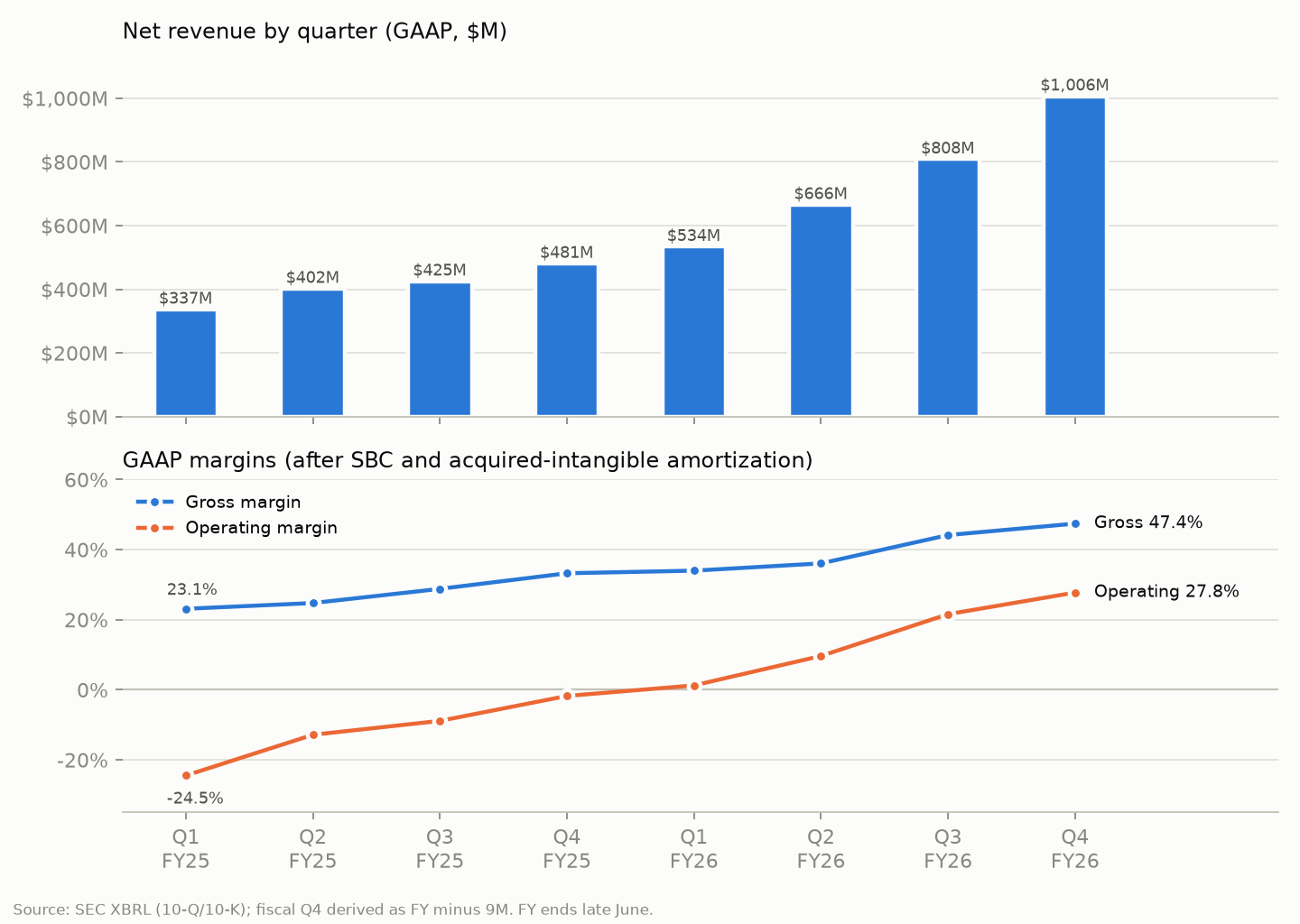
The 10-K breaks down the gain. About 54% of the increase in gross margin dollars came from lower manufacturing costs relative to revenue, mainly higher internal factory utilization, 29% from a shift toward higher-margin products and 17% from lower amortization of acquired intangibles. Below gross profit, operating costs rose far more slowly than revenue: between the fourth quarter of fiscal 2025 and the fourth quarter of fiscal 2026, revenue rose $525.6 million while research and development plus selling and administrative costs rose $32.5 million, from $163.1 million to $195.6 million. And the chief financial officer named higher prices on certain products as one driver of the fourth-quarter gross margin, according to a MarketBeat summary of the call.
Anyone reading the company’s own presentations will see a wide gap between GAAP and non-GAAP operating profit. Most of it is stock-based compensation and the amortization of intangible assets from past acquisitions. I treat both as real costs, and the GAAP figures above include them.
Fiscal 2026 also shows a GAAP net loss of $6,935.1 million. Behind it is a $7,756.6 million non-cash loss on retiring convertible notes that holders exchanged for shares after the stock had risen far above the conversion prices. Shareholders paid for that through dilution.
Cash arrives later than profit
The 10-K shows operating cash flow of $751.4 million in fiscal 2026. Capital spending was $451.3 million, nearly double the $231.0 million of fiscal 2025, which leaves about $300 million of free cash flow on $3 billion of revenue. Inventories also rose, from $470.1 million to $691.6 million.
A manufacturer adding capacity into a shortage usually looks like this. Lumentum also bought a factory in Greensboro, North Carolina, in March 2026, and Hurlston told the same May conference that it would not reach production for two years. For the next few years the question is how much of each revenue dollar has to go back into fabs before any of it reaches shareholders.
The debates
How long the shortage lasts. In May, Hurlston put the gap between demand and supply for EML lasers at more than 30% and said the company was targeting another 50% increase in EML units. In August, management described pump lasers as effectively sold out. A shortage is what lets a component maker raise prices, and new capacity elsewhere is what ends it. Coherent, which already makes indium phosphide lasers on six-inch wafers, said on its May earnings call that it expected to double its internal indium phosphide capacity by the end of calendar 2026. Lumentum says it has seen no impact so far from potential new Chinese indium phosphide capacity. If new capacity starts to bite, gross margin is where it would show, though product mix and fab utilization move that number too.
Whether the mix keeps improving. Hurlston described cloud transceivers as the lowest-margin part of the portfolio and the part where Chinese competition is most relevant, which puts the laser chips from Lumentum’s own fabs higher up. He also expects transceiver revenue to double over the next four to five quarters. Growth there adds gross profit dollars and can still pull the margin percentage down.
What comes after pluggable modules. Optical circuit switches are new, and management expects the September 2026 quarter to be the first with more than $100 million of switch revenue. Further out, co-packaged optics moves the optical engine next to the switch chip and puts the laser in a separate external light source module. Lumentum told investors in August that it has its first purchase order for such a module, for delivery by the second half of calendar 2027. I think that shift mostly changes who assembles the optics; demand for indium phosphide lasers still depends on how many optical links get built.
Customer concentration. Customer A accounts for more than a quarter of revenue, and NVIDIA has $2.0 billion invested in Lumentum’s equity. The filing does not say whether they are the same company. Either way, one buyer at that scale can reset Lumentum’s volumes on its own, and the risk becomes real if that buyer qualifies a second laser supplier. How long a buyer that size keeps ordering depends on how it pays for the build-out, which the site’s piece on AI depreciation and the Burry argument works through.
Reproduce it in Python
The code below, run on 22 October 2026 against Lumentum’s XBRL data, reproduces the annual revenue, margin, net loss, cash flow, inventory and share-count figures in this post. The fourth-quarter figures, the revenue splits by category, customer and region, the old Industrial Tech segment, the gross margin breakdown and the NVIDIA preferred stock terms come from the filings and releases linked in the text. The code needs Python with pandas and requests. The site’s series on Python for fundamental analysis covers the same steps in more detail, starting with retrieving financial statements, and has posts on profitability ratios and free cash flow.
The SEC asks every automated request to say who is calling, so set your own contact before running it. The first block looks up Lumentum’s SEC identifier and pulls the values reported in its 10-K filings: full-year flows, and year-end balances for items like inventory.
import os
import requests
import pandas as pd

# The SEC asks every automated request to identify itself. Set your own contact first:
#   export SEC_USER_AGENT="Your Name you@example.com"
HEADERS = {"User-Agent": os.environ["SEC_USER_AGENT"]}

def company_facts(ticker):
    """All XBRL facts a company has filed with the SEC."""
    tickers = requests.get("https://www.sec.gov/files/company_tickers.json", headers=HEADERS, timeout=30).json()
    cik = next(v["cik_str"] for v in tickers.values() if v["ticker"] == ticker)
    url = f"https://data.sec.gov/api/xbrl/companyfacts/CIK{cik:010d}.json"
    return requests.get(url, headers=HEADERS, timeout=30).json()

def from_10k(facts, concept, taxonomy="us-gaap", unit="USD"):
    """Values reported in 10-K filings: full-year flows, or year-end balances when there is no start date."""
    df = pd.DataFrame(facts["facts"][taxonomy][concept]["units"][unit])
    df = df[df["form"] == "10-K"]
    if "start" in df and df["start"].notna().any():
        df = df[df["start"].notna()].copy()
        days = (pd.to_datetime(df["end"]) - pd.to_datetime(df["start"])).dt.days
        df = df[days.between(350, 380)]
    return df.sort_values("filed").drop_duplicates("end", keep="last").set_index("end")["val"]
The second block collects the line items the article uses and turns them into ratios.
facts = company_facts("LITE")
lines = {
    "revenue": "RevenueFromContractWithCustomerExcludingAssessedTax",
    "gross_profit": "GrossProfit",
    "operating_income": "OperatingIncomeLoss",
    "research": "ResearchAndDevelopmentExpense",
    "net_income": "NetIncomeLoss",
    "debt_extinguishment": "GainsLossesOnExtinguishmentOfDebt",
    "operating_cash_flow": "NetCashProvidedByUsedInOperatingActivities",
    "capex": "PaymentsToAcquirePropertyPlantAndEquipment",
    "inventory": "InventoryNet",
}
data = pd.DataFrame({name: from_10k(facts, concept) for name, concept in lines.items()}).tail(4)
data["gross_margin"] = data["gross_profit"] / data["revenue"]
data["operating_margin"] = data["operating_income"] / data["revenue"]
data["research_share"] = data["research"] / data["revenue"]
data["free_cash_flow"] = data["operating_cash_flow"] - data["capex"]
print(data[["revenue", "gross_margin", "operating_margin", "research_share", "free_cash_flow"]].round(3).to_string())

# Shares outstanding on the cover of the last two 10-Ks
cover = from_10k(facts, "EntityCommonStockSharesOutstanding", taxonomy="dei", unit="shares").tail(2)
print(cover)

fy24, fy25, fy26 = data.index[-3], data.index[-2], data.index[-1]
figures = {
    "revenue_fy2026": data.loc[fy26, "revenue"],
    "revenue_fy2025": data.loc[fy25, "revenue"],
    "revenue_fy2024": data.loc[fy24, "revenue"],
    "revenue_decline_fy2024": 1 - data.loc[fy24, "revenue"] / data["revenue"].iloc[-4],
    "gross_margin_fy2024": data.loc[fy24, "gross_margin"],
    "gross_margin_fy2026": data.loc[fy26, "gross_margin"],
    "operating_loss_fy2024": -data.loc[fy24, "operating_income"],
    "operating_loss_fy2025": -data.loc[fy25, "operating_income"],
    "operating_income_fy2026": data.loc[fy26, "operating_income"],
    "research_share_fy2025": data.loc[fy25, "research_share"],
    "research_share_fy2026": data.loc[fy26, "research_share"],
    "net_loss_fy2026": -data.loc[fy26, "net_income"],
    "extinguishment_loss_fy2026": -data.loc[fy26, "debt_extinguishment"],
    "operating_cash_flow_fy2026": data.loc[fy26, "operating_cash_flow"],
    "capex_fy2026": data.loc[fy26, "capex"],
    "capex_fy2025": data.loc[fy25, "capex"],
    "free_cash_flow_fy2026": data.loc[fy26, "free_cash_flow"],
    "inventory_fy2025": data.loc[fy25, "inventory"],
    "inventory_fy2026": data.loc[fy26, "inventory"],
    "shares_cover_previous": cover.iloc[0],
    "shares_cover_latest": cover.iloc[1],
    "share_increase": cover.iloc[1] / cover.iloc[0] - 1,
}
figures = {k: float(v) for k, v in figures.items()}
The second block prints four fiscal years side by side, then the share counts from the last two 10-K covers. Two numbers in that output say something the text above only implies. Research and development fell from 18.5% of revenue in fiscal 2025 to 11.8% in fiscal 2026, because revenue grew much faster than research spending. And the cover of the latest 10-K counts 89.7 million shares outstanding against 69.9 million on the cover of the one before, an increase of 28.3% in the year of the note exchanges described above.
What to watch
Lumentum reports the quarter that ended in late September on 5 November 2026. Management guided to revenue of $1.225 billion to $1.275 billion and a non-GAAP operating margin of 39.5% to 40.5%, per the Q4 FY2026 results release.
Gross margin reflects pricing, product mix and fab utilization together, so it bears on the first two debates at once. The split between components and systems shows the mix, and the first quarter of optical circuit switch revenue above $100 million tests the newest product. Capital spending against operating cash flow shows how much of the profit stays in the business. The next 10-K will show whether the two largest customers grew their share again.
Risks
Two risks sit outside the debates above. The convertible notes due 2026, 2028, 2029 and 2032 are still outstanding, and the 10-K lets the company settle conversion value above principal in shares, so the dilution that started in fiscal 2026 may not be over. NVIDIA’s preferred stock also converts into common shares one for one. The other risk is timing. External light sources for co-packaged optics and the Greensboro fab have not reached volume production, and a large part of the growth plan rests on both.
My longer company research is published on the newsletter Sector Playbook, which is available by email subscription.
Sources
Lumentum Form 10-K for the fiscal year ended 27 June 2026; fourth-quarter fiscal 2026 results release, 11 August 2026; fourth-quarter fiscal 2025 results release; MarketBeat summary of the Q4 fiscal 2026 earnings call; TIKR summary of the CEO’s JPMorgan conference remarks, May 2026; Coherent fiscal Q3 2026 earnings call.
Disclaimer
This article is general information about a listed company, written for educational purposes. It is not investment advice and not a personal recommendation to buy, sell or hold any security, and it does not take into account anyone’s financial situation or objectives. I am not a registered investment adviser or a licensed financial services provider. Figures come from company filings and the other sources linked in the text, as of the dates given, and may have changed since. I may hold positions in the securities discussed; see the disclosure above. Investment decisions call for independent research or the advice of a licensed professional.
This is my own research, done with the help of AI tools.