Skip to content

Python & Finance Hub

  • Python for FinanceExpand
    • Portfolio Management
    • Fundamental Analysis
    • Screeners
    • Technical Analysis & Indicators
  • AI for Finance Research
  • Company & Sector Deep DivesExpand
    • Health Care (GICS 35): KPIs, Valuation Notes, and Deep Dives
    • Information Technology — Sector Hub (GICS 45)
  • Market AnalysisExpand
    • Asset Class Analysis (e.g., Bonds, Equities, ETFs)
    • Interest Rates & Monetary Policy
    • Analytical Tools & Methods
    • Semiconductors
    • Financial Sector
    • Technology
  • Privacy Policy
Python & Finance Hub
  • Earnings call with Python
    Fundamental Analysis | Python for Finance

    8. Python for Fundamental Analysis: Unlock Insights with Earnings Call Transcript Analysis

    ByJose Manuel May 2, 2025November 21, 2026

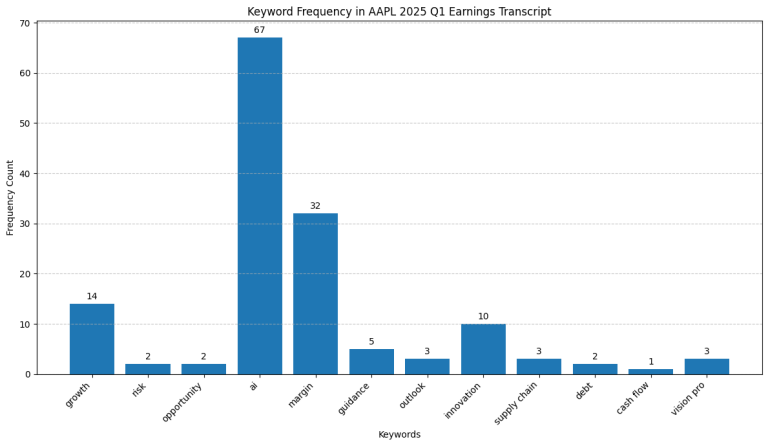
    Welcome back to the Python for Fundamental Analysis series! We’ve built a strong quantitative toolkit over the last posts: While numbers are essential, they don’t capture management strategy, competitive dynamics, outlook, or the nuances behind performance. For this, we turn to qualitative sources, and one of the richest is the earnings call transcript. These quarterly calls offer direct…
    Read More 8. Python for Fundamental Analysis: Unlock Insights with Earnings Call Transcript AnalysisContinue

  • Peer analysis python
    Fundamental Analysis | Python for Finance

    7. Python for Fundamental Analysis: Automate Peer Company Analysis & Benchmarking

    ByJose Manuel May 2, 2025October 22, 2026

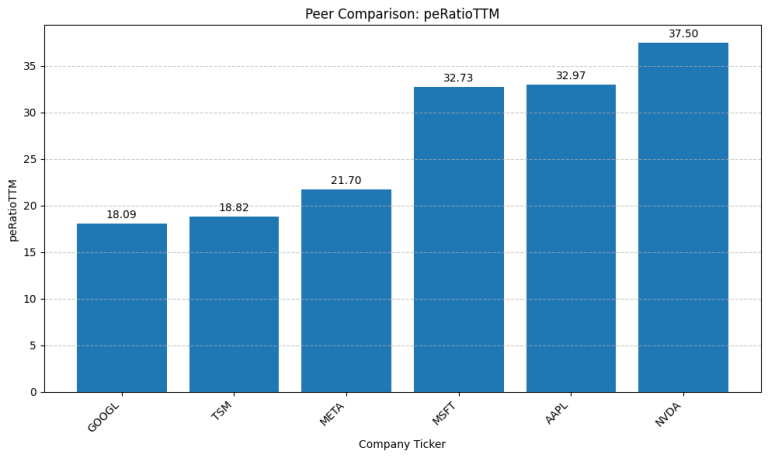
    Welcome back to the Python for Fundamental Analysis series! We’ve built a solid foundation by calculating individual metrics and ratios for single companies. Check out the previous posts: Analyzing a company in isolation, however, only tells part of the story. Is a P/E ratio of 25 high or low? Is a Net Profit Margin of 15% good…

    Read More 7. Python for Fundamental Analysis: Automate Peer Company Analysis & BenchmarkingContinue

  • Python turnover ratios
    Fundamental Analysis | Python for Finance

    6. Python for Fundamental Analysis: Boost Your Analysis with Efficiency Ratios (Turnover)

    ByJose Manuel May 1, 2025October 22, 2026

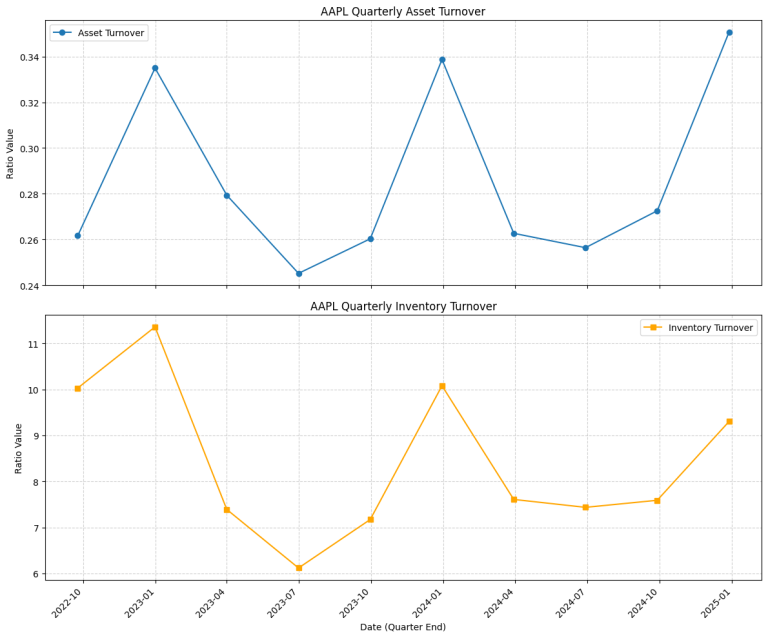
    Introduction: How Well Are Assets Being Used? Welcome back to the Python for Finance series! We’ve journeyed through valuation, data retrieval, profitability, liquidity, and leverage. If you missed any previous posts, you can catch up here: Now, we shift our focus to Efficiency Ratios, also known as Activity Ratios or Turnover Ratios. These ratios measure how effectively a…

    Read More 6. Python for Fundamental Analysis: Boost Your Analysis with Efficiency Ratios (Turnover)Continue

  • Python and debt to equity ratio
    Fundamental Analysis | Python for Finance

    5. Python for Fundamental Analysis: Company Leverage with Debt-to-Equity Ratio

    ByJose Manuel May 1, 2025October 22, 2026

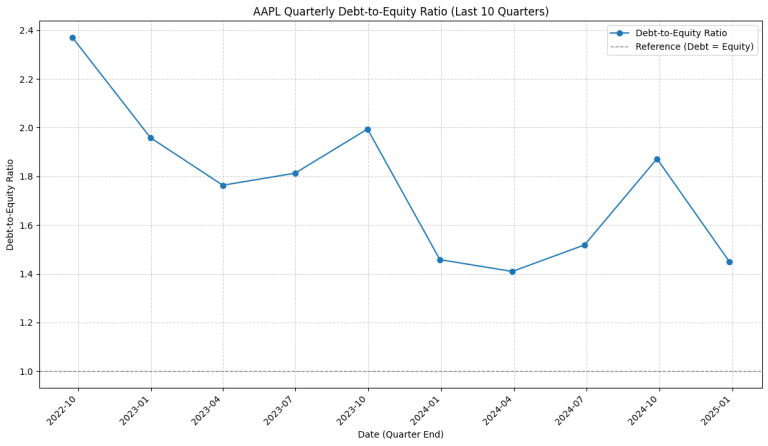
    Welcome back to the Python for Finance series! Having explored valuation (Post 1), financial statements (Post 2), profitability (Post 3), and liquidity (Post 4), we now examine another crucial aspect: Leverage. Leverage involves using debt to finance operations and assets. While it can magnify returns, it also increases financial risk, making companies more vulnerable during downturns due to…

    Read More 5. Python for Fundamental Analysis: Company Leverage with Debt-to-Equity RatioContinue

  • Analyze Liquidity Ratios with Python
    Fundamental Analysis | Python for Finance

    4. Python for Fundamental Analysis: Analyze Liquidity Ratios with Python

    ByJose Manuel April 30, 2025October 22, 2026

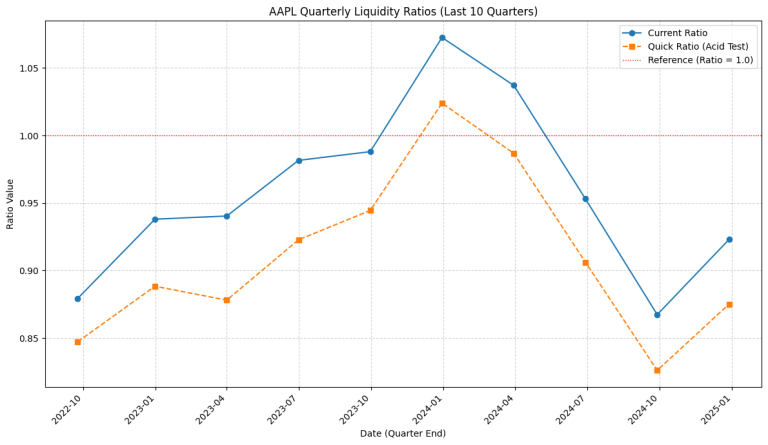
     Welcome back to the Python for Finance series! In our previous posts, we’ve fetched specific metrics like P/E (Post 1), retrieved full financial statements (Post 2), and visualized profitability trends (Post 3). Now, we shift our focus from profitability to another critical aspect of fundamental analysis: Liquidity. Liquidity refers to a company’s ability to meet its short-term financial…

    Read More 4. Python for Fundamental Analysis: Analyze Liquidity Ratios with PythonContinue

  • Profitability ratios python
    Fundamental Analysis | Python for Finance

    3. Python for Fundamental Analysis: Analyze Profitability Ratios with Python

    ByJose Manuel April 30, 2025October 22, 2026

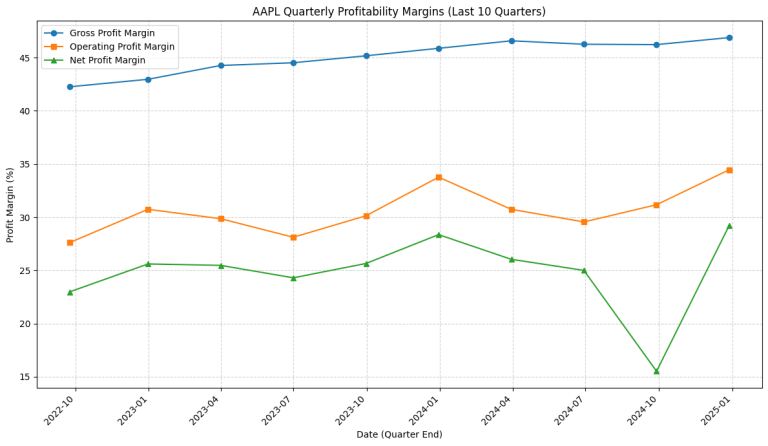
    Welcome back to our Python for Finance series! In the previous post (Post 2), we successfully automated the retrieval of the three core financial statements – the Income Statement, Balance Sheet, and Cash Flow Statement – using Python and the Financial Modeling Prep (FMP) API. We saw how pandas helps structure this data effectively. But raw financial statements, while informative,…

    Read More 3. Python for Fundamental Analysis: Analyze Profitability Ratios with PythonContinue

  • Retrieve financials with python
    Fundamental Analysis | Python for Finance

    2. Python for Fundamental Analysis: Automate Financial Statement Retrieval with Python

    ByJose Manuel April 29, 2025October 24, 2026

    Welcome back to the Python for Finance series! In our first post, we calculated the P/E ratio, seeing how Python could automate fetching specific data points. However, as insightful as ratios like P/E are, they are derived from the company’s core financial reports. To truly understand why a P/E ratio is high or low, or to assess a company’s overall…

    Read More 2. Python for Fundamental Analysis: Automate Financial Statement Retrieval with PythonContinue

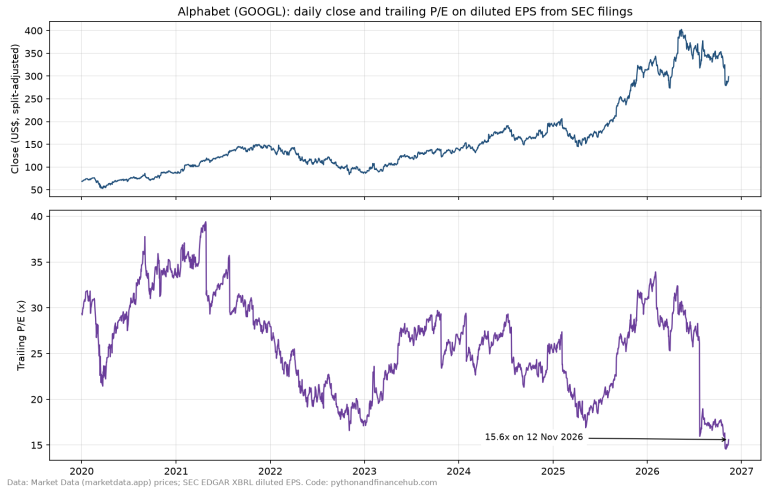
  • Two-panel chart of Alphabet (GOOGL) from January 2020 to November 2026: the split-adjusted daily close on top and the trailing P/E on diluted EPS from SEC filings below, ending at the close of 12 November 2026
    Fundamental Analysis | Python for Finance

    How to calculate the P/E ratio in Python from SEC filings

    ByJose Manuel April 28, 2025November 23, 2026

    Calculate Alphabet’s trailing P/E ratio in Python from diluted EPS in its 10-K and 10-Q XBRL data and a dated Market Data close, then see how much of the E came from gains on equity securities.

    Read More How to calculate the P/E ratio in Python from SEC filingsContinue

  • 4. Python Screener for Growth, Value and Momentum stocks
    Python for Finance | Screeners

    4. Python Screener for Growth, Value and Momentum stocks

    ByJose Manuel April 26, 2025November 3, 2026

    In our journey through building Python stock screeners, we’ve looked at value, dividends, and pure growth strategies individually. But what if you want the best of both worlds? This post dives into multi-factor stock screening with Python, demonstrating how to combine criteria – specifically creating a Growth at a Reasonable Price (GARP) screener and adding a basic technical trend filter. Why Combine…

    Read More 4. Python Screener for Growth, Value and Momentum stocksContinue

  • Python stock screener high growth
    Python for Finance | Screeners

    3. Python Growth Stock Screener

    ByJose Manuel April 25, 2025October 22, 2026

    Welcome back to our Python for Finance series! Having explored value stocks and dividend payers, we now turn our attention to another exciting category: growth stocks. This post will show you how to build a Python growth stock screener to identify companies exhibiting strong expansion potential using yfinance and pandas. What is a Growth Stock? Growth investing focuses on companies expected to grow their…

    Read More 3. Python Growth Stock ScreenerContinue

Page navigation

Previous PagePrevious 1 … 5 6 7 8 9 … 11 Next PageNext
  • About
  • Legal Notice (Imprint)
  • Terms and Conditions
  • Privacy Policy

Footer

  • About
  • Legal Notice (Imprint)
  • Terms and Conditions
  • Privacy Policy

We improve our products and advertising by using Microsoft Clarity to see how you use our website. By using our site, you agree that we and Microsoft can collect and use this data. Our privacy statement (link) has more details.

  • Python for Finance
    • Portfolio Management
    • Fundamental Analysis
    • Screeners
    • Technical Analysis & Indicators
  • AI for Finance Research
  • Company & Sector Deep Dives
    • Health Care (GICS 35): KPIs, Valuation Notes, and Deep Dives
    • Information Technology — Sector Hub (GICS 45)
  • Market Analysis
    • Asset Class Analysis (e.g., Bonds, Equities, ETFs)
    • Interest Rates & Monetary Policy
    • Analytical Tools & Methods
    • Semiconductors
    • Financial Sector
    • Technology
  • Privacy Policy
Search